regain documentation
Native Windows ASCOM
Local camera and accessory drivers with matching setup dialogs, for both 32-bit and 64-bit clients.
The native drivers launch local Rust workers. They do not connect through an Alpaca bridge and do not require an Alpaca server.
Keep the ASCOM side small
The camera driver is a thin .NET Framework COM adapter. Capture and recovery run in Rust workers over private binary pipes, with the camera SDK isolated in its worker when SDK mode is selected. This provides a local connection without an HTTP server or vendor control application. The native adapter still requires .NET Framework and ASCOM Platform.
Install and connect
- Install the requirements listed in Install & upgrade.
- Download the regain ASCOM setup executable from the release page. Close device-control apps and running Alpaca servers, then run the installer as administrator.
- In your application’s ASCOM Chooser, select a regain camera, CAA rotator, EFW filter wheel, EAF focuser, Pegasus FocusCube3, or Deep Sky Dad OFP2 (current source/CI builds).
- Open Setup, refresh devices, select the physical device, and configure its settings. Close setup and connect from your application.
The Start menu contains camera and accessory setup shortcuts. Four camera entries provide independent settings: Retryable Camera 1 through 4. Configure cameras 2–4 from their own Chooser entries.
Connect more than two cameras
For example, assign Retryable Camera 1 to your main imaging camera, 2 to the guider, and 3 to a second imaging train. A fourth entry is available for another camera. These are separate configurations for distinct physical devices, available to both 32-bit and 64-bit ASCOM clients.
- Open each camera entry’s own Setup dialog.
- Select its physical camera and save a distinct serial, especially when models match.
- Choose that camera’s SDK or Direct USB backend and recovery settings.
- Close setup, then connect the corresponding entry in each imaging application.
A missing or busy saved camera fails connection instead of silently selecting another one. For network clients, use Alpaca camera slots; their device numbers and UUIDs remain stable when changing the selected physical camera.
Matching controls
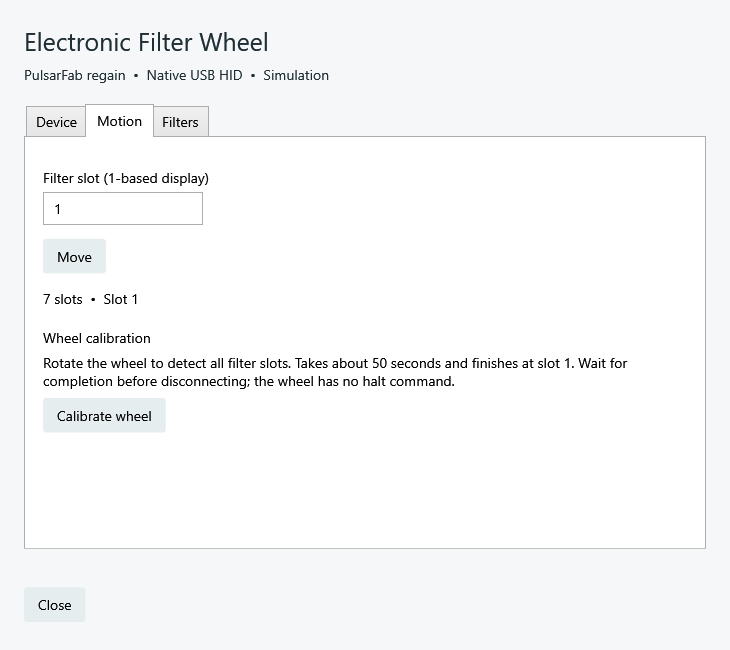
Camera setup groups device selection, recovery, cooler, and timeout settings. Accessory dialogs expose device selection, motion, and device settings in the same style. Standalone dialogs use a light theme; NINA-hosted controls inherit its theme.
OFP2 cover and flat panel
Current source and CI builds add PulsarFab regain Deep Sky Dad OFP2 to the CoverCalibrator chooser. It shares one serial connection across 32-bit and 64-bit ASCOM clients and provides the same style of setup dialog. NINA can select it as an ASCOM flat panel. Release 0.4.0.0 includes Alpaca support only. See OFP2 setup and sharing.
ETA tilt and back focus
Current source/CI builds add PulsarFab regain Wanderer Astro ETA M54 to the focuser chooser, with the shared serial server and setup dialog used by other regain accessories. Read the ETA guide for movement limits and the absence of a hardware halt command. Physical movement validation is pending.
FocusCube3 sharing
FocusCube3 uses one out-of-process COM server across 32-bit and 64-bit applications. Each client has its own connection lease; disconnecting one leaves the others connected. This sharing does not extend to native NINA, Alpaca, or Unity. See FocusCube3 setup.
Portable registration
Extract the complete ASCOM ZIP to a permanent folder. In an administrator PowerShell opened there:
$p = Start-Process .\Regain.ASCOM.Register.exe -ArgumentList /regserver -Wait -PassThru
if ($p.ExitCode) { throw 'Registration failed; check the registration log' }
Use /unregserver before deleting a portable install. Keep assemblies, Rust workers, and SDK libraries together. The old ASCOM.ZWOgain.* ProgIDs are intentionally preserved for compatibility.
Updates and validation
The installer refuses to replace files in use. No background service or firewall rule is installed automatically. Settings survive upgrades and uninstall. Automated COM and simulator checks cover both client bitnesses; a full ASCOM ConformU run remains outstanding.